Case study 01
·
Product design
AI-Powered
Legal Research
Designing a chat interface that starts from what attorneys know, not what they can already name.
Designing a chat interface that starts from what attorneys know, not what they can already name.
An attorney gets a case. A child was injured on a construction site next to an apartment complex. There was a gap in the fence. A prior inspection had flagged it. The parents are suing both the contractor and the property owner.
She needs to find precedent — cases where courts held a property owner responsible for an injury that happened on a neighbouring site.
She opens the search tool and types:
Nothing useful comes back.
The case she needs is filed under "attractive nuisance" — when a property pulls children toward danger, the owner can be held responsible. She hasn't thought to search for that yet. She knows the story. The tool needs the term.
That gap — between what she knows and what the tool requires — is what this project was built to close.
Before AI, legal research ran on boolean search. Boolean is a query language — attorneys string together keywords with logical operators like AND, OR, and NOT to tell the database exactly what to find.
It works — if you already know the right terms. If you already know the category. If you already know the jurisdiction. Most people searching don't know any of those things yet.
The attorney has to know the answer before she can find the answer.
Boolean search
"premises liability" AND ("construction site" OR "adjacent property") AND "child"
Natural language
A child was hurt on a construction site next to an apartment building. The fence had a gap that had been flagged before. Who is liable?
Same situation. Different search terms. Only one works.
I interviewed attorneys about how research actually starts in practice — not how they describe it in theory, but what they do when a new case lands on the desk. The answer was consistent:
Research doesn't start with a query. It starts with a story.
"The same motion has twelve different names depending on the state. Boolean treats them as twelve different things."
Senior litigation attorney · interview, 2025
"Good research means holding several categories and practice areas in your head at once. The same case can fall under five different theories."
Senior litigation attorney · interview, 2025
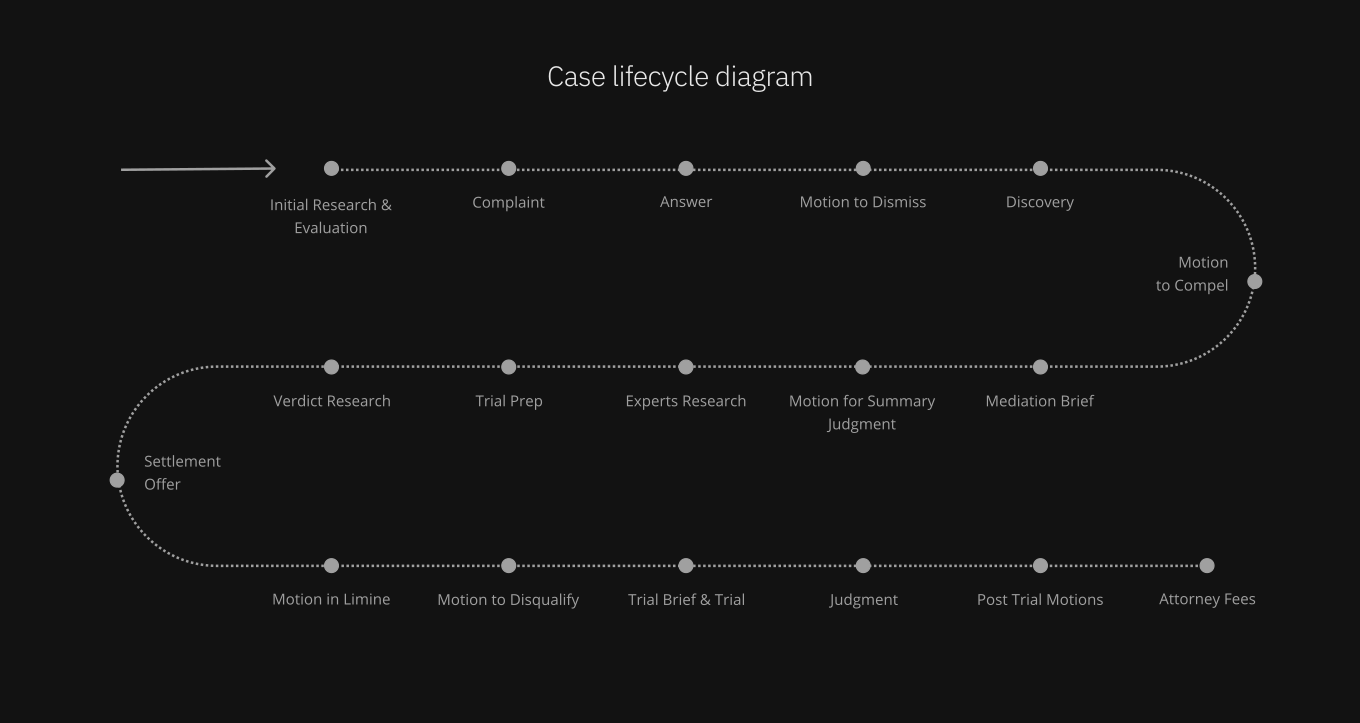
Legal research also isn't a single event. It happens at every stage of a case — deciding whether to take it, preparing depositions, drafting motions, building arguments for trial. A motion for summary judgment alone can take weeks. Each stage starts from what the attorney already knows and asks how courts have handled it before.
01
Attorneys think in stories, not search terms.
They know the facts of a case long before they know the legal categories that apply. Boolean wants the reverse — you need the category to find the case that would have taught you the category.
02
Research never really stops.
A single case needs many separate research sessions across its life. Each one builds on the last, and the context piles up over weeks.
03
Every finding needs a source.
Attorneys collect quotes into a running research doc and go back to original filings to draft. A summary with no traceable source can't be used — they're liable for everything they file.
04
Terminology shifts by jurisdiction.
The same idea is filed under different words from one state to the next. A keyword search treats those as different things. Context-aware search bridges them.
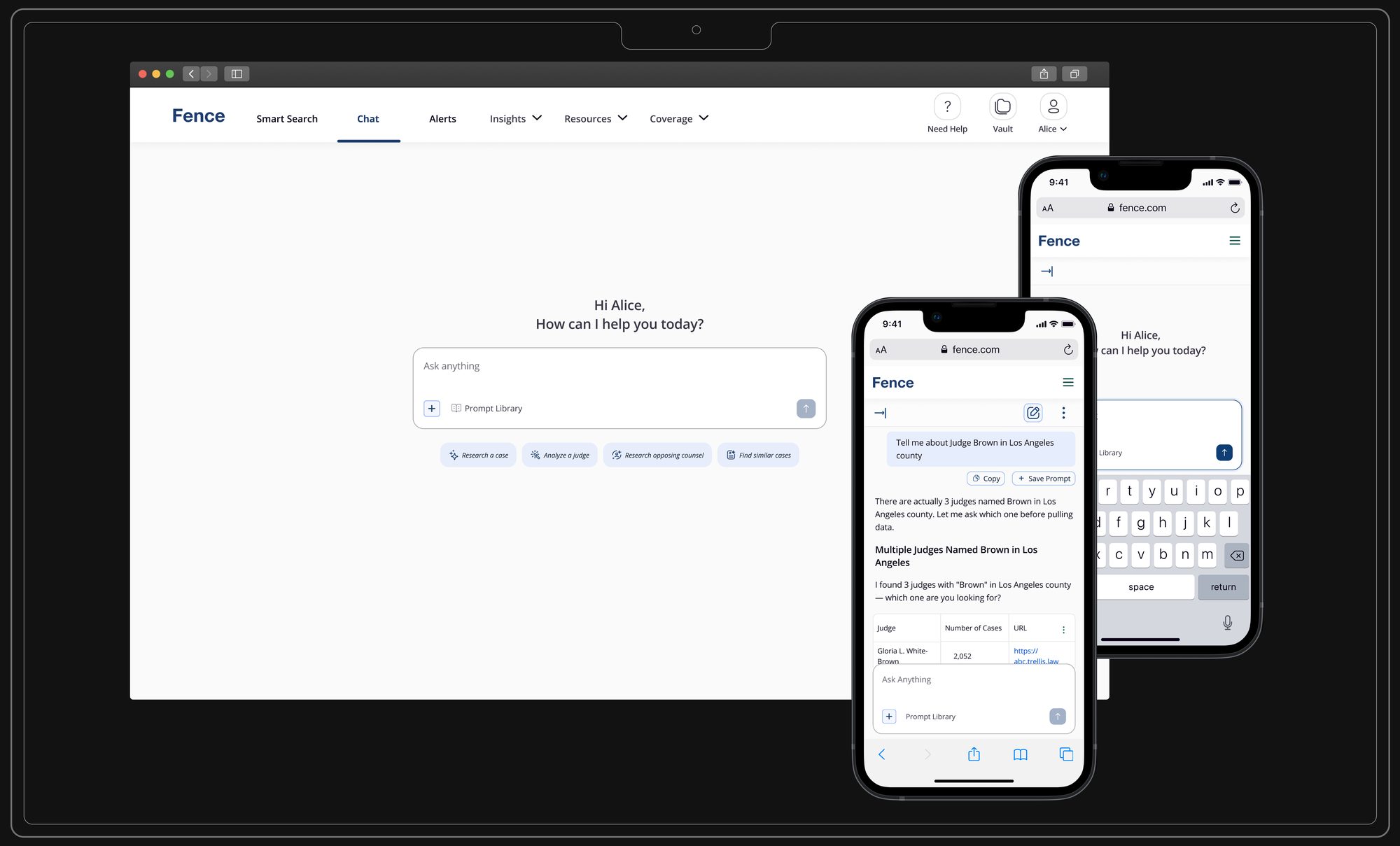
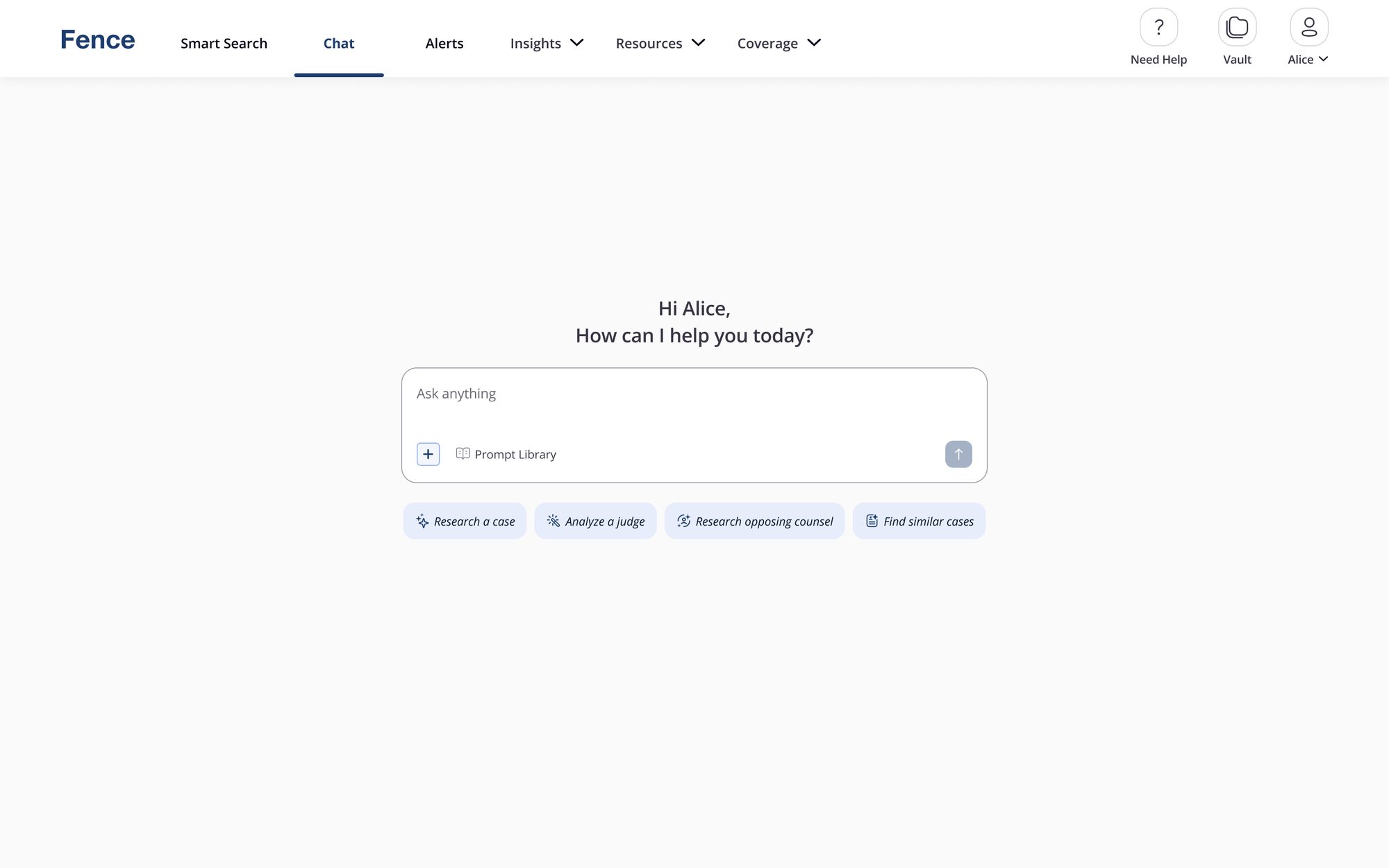
Attorneys don't walk in with keywords. They walk in with a story — the facts of a case, in their own words, sometimes with the documents to back it up. That's why the first screen isn't a search bar. It's a single input, ready to listen, with a document to attach or a shortcut from the prompt library close at hand.
Plain language
No query syntax to learn — ask the way you'd ask a colleague.
Attachments
Bring your own documents directly into the conversation.
Prompt library
Pre-built starting points for tasks that repeat often.
Four shortcuts, pulled straight from the prompt library.
Chat interaction
When a query is ambiguous, the system pauses and asks — never guesses.
"The problem isn't when it's obviously wrong. It's when it sounds confident."
Attorney · user interview, 2025
Prompt library
Some questions repeat on nearly every case. The library keeps them ready.
Same shortcuts, everywhere
The same four prompts, reachable from any chat.
Save from chat
Turn any query into a prompt, or build one fresh.
Bookmark favorites
The ones that matter, bookmarked and one tap away.
In research sessions, attorneys ran the same query types repeatedly across different cases — judge analysis, opposing counsel history, similar verdicts. A library of reusable starting points removed real friction. Saving custom prompts extended that to firm-specific workflows.
When AI chat tools became widely available, attorneys started using them immediately. The speed was obvious. So was the risk.
General AI — even with connectors that reach an external database — has one problem for legal work: it gives you an answer, not the evidence. You get a confident summary. You don't get a numbered chain of claims, each tied to the exact passage in a real filing. You can't check the work before you rely on it.
Tools like Harvey and Legora solve part of this. They're built for legal work, with real database access and proper citations. But they're enterprise products — priced for large firms, sold on firm-wide contracts. A solo attorney, a small practice, or someone who isn't a lawyer at all can't get to them.
| What research needs | Boolean Westlaw, Lexis |
General AI + connectors |
Enterprise legal AI Harvey, Legora |
Our approach |
|---|---|---|---|---|
| Natural-language input | — | ✓ | ✓ | ✓ |
| Verified legal database | ✓ | partial | ✓ | ✓ |
| Citations linked to source passages | — | — | ✓ | ✓ |
| Analyse a whole Vault of documents | — | — | ✓ | ✓ |
| Available without an enterprise contract | ✓ | ✓ | — | ✓ |
The gap was a tool that put all four together — search that understands context, a verified database, citations you can open, and a price that isn't enterprise-only.
"Since AI tools became common, there are moments where I think — I really wish I'd had this when I was practising. Where could it have saved me the most time?"
Senior attorney · user interview, 2025
Citations
Every response is numbered. Each number maps to a specific source document — not "source: legal database" but an actual filing, with the exact passage quoted in a panel beside the answer. The attorney can open it, read the full context, and decide whether to use it.
Numbered citations
Every claim maps to a specific numbered source, not a vague database reference.
Exact passage
The quoted text sits in a panel beside the answer — no hunting through the full filing to check it.
Full filing on demand
One click opens the source document itself, in full context, when a passage isn't enough.
"Research you can't check isn't research. It's a suggestion."
Design principle · non-negotiable
Vault
Legal research isn't one conversation about one document. By the time an attorney is seriously working a case, they've built a collection — motions, rulings from the same judge, expert witness bios, cases from other jurisdictions, their own uploaded documents. Weeks of accumulated work.
Persists across sessions
Nothing resets. Documents and findings stay in the workspace as the case develops.
Save or upload
Pull from the database or bring your own files into the same collection.
One shared context
The chat reasons across everything in the Vault at once, not document by document.
"Information is collected in a running research document — snippets and quotes with links to sources. Attorneys synthesize findings to build arguments based on precedent rather than creating from scratch."
Legal research session · 2025
The hardest constraint in this project wasn't the interface. It was trust.
Attorneys are professionally liable for everything they file. And anyone using a legal platform to understand their own situation — a lawsuit, a dispute, a question about their rights — is making real decisions based on what they find. An AI that sounds confident but can't be verified isn't just unhelpful. In a legal context, it can do real harm.
Every decision here — the citations panel, the disambiguation step, the Vault, the exact wording — was ultimately about making the system's reasoning visible. Not just what it concluded. What it looked at. What it found. What it didn't.
Legal research tools were built for how attorneys were trained to search.
This was built for how people actually think.